
Fire Safety Booklet
Eight Voices, One Vision
Fire Safety Booklet
Eight Voices, One Vision
TYPE
Team Project | Illustration | Print
CLIENT
Burnaby Fire Department
TIMELINE
Apr-Sept 2025
TYPE
Team Project | Illustration | Print
CLIENT
Burnaby Fire Department
TIMELINE
April–Sept 2025

Challenge:
To redesign and enhance a Fire Safety Activity Book for Burnaby elementary school students from Kindergarten to Grade 3

The team
8
Graphic Designers
The Users
43
Burnaby Elementary Schools
Challenge:
To redesign and enhance a Fire Safety Activity Book for Burnaby elementary school students from Kindergarten to Grade 3
The team
8
Graphic Designers
The Users
43
K to Grade 3 Elementary Schools
Fire Safety Booklet
What is it?
A booklet to teach children about fire safety in a fun and interactive way.
Usage
Used as presentation handouts for the fire safety public education program.
Target Audience
Kindergarten to Grade 3 Burnaby elementary school students
What is a fire safety booklet?
A booklet to help teach young children about fire safety in a fun and interactive way.
The Original Version
Designed by Burnaby Fire Chief Paul Rushton, the original activity book contained valuable information. However, many of its visuals were sourced from Canva and included pixelated vectors, logos, and images.
The team’s goal is to create a refreshed, cohesive version featuring original illustrations that accurately represent the content while also lowering overall printing costs.


The Original Version
Designed by Burnaby Fire Chief Paul Rushton, the original activity book contained valuable information. However, many of its visuals were sourced from Canva and included pixelated vectors, logos, and images.
The team’s goal is to create a refreshed, cohesive version featuring original illustrations that accurately represent the content while also lowering overall printing costs.


RESEARCH
What's out there?
We researched other fire safety activity books from National Fire Protection Association (NFPA) to gather ideas and identify age-appropriate activities.
RESEARCH
What's out there?
We researched other fire safety activity books from National Fire Protection Association (NFPA) to gather ideas and identify age-appropriate activities.


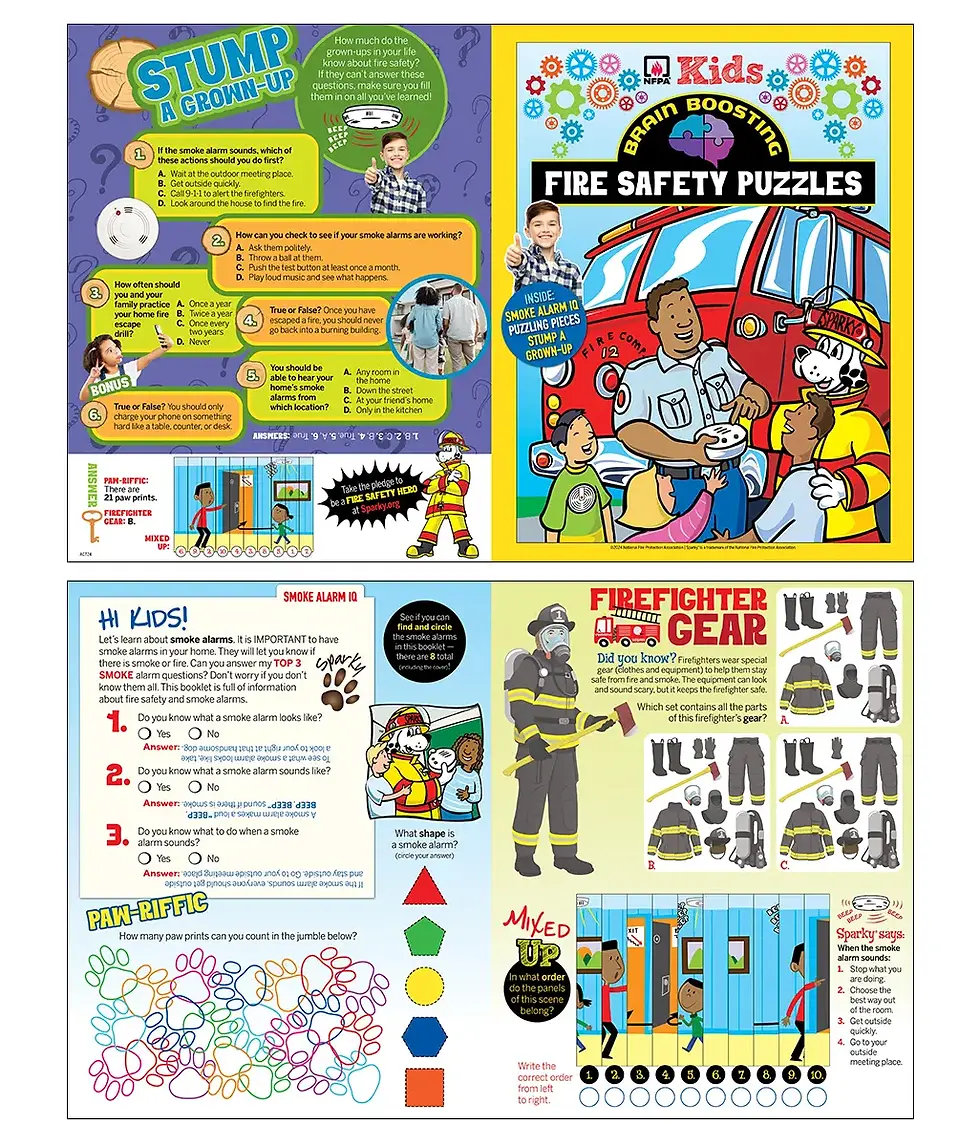
Based on assessment of the original version and secondary research, we brainstormed questions to ask the client.
MEETING THE CLIENT
Understanding Needs
Based on assessment of the original version and secondary research, we brainstormed questions to ask the client.
What are the key sections of the booklet?
What are the most important fire tips to be included?
What's the estimated budget for each booklet?
What are the guidelines around the usage of Sparky, the mascot?
Other mandatory requirements like the City of Burnaby and fire department logo?
Diversity/accessibility considerations?
Brainstorming
This is a paragraph area where you can include any information you’d like. It’s an opportunity to tell a story about the business or describe a special service or product it offers. You can use this space to share the company history or highlight a particular feature that sets it apart from competitors.
Let the writing speak for itself. Keep a consistent tone and voice throughout the website to stay true to the brand image and give visitors a taste of the company’s values and personality.

Service Name
This is a paragraph area where you can include any information you’d like. It’s an opportunity to tell a story about the business or describe a special service or product it offers. You can use this space to share the company history or highlight a particular feature that sets it apart from competitors.
Let the writing speak for itself. Keep a consistent tone and voice throughout the website to stay true to the brand image and give visitors a taste of the company’s values and personality.

Service Name
This is a paragraph area where you can include any information you’d like. It’s an opportunity to tell a story about the business or describe a special service or product it offers. You can use this space to share the company history or highlight a particular feature that sets it apart from competitors.
Let the writing speak for itself. Keep a consistent tone and voice throughout the website to stay true to the brand image and give visitors a taste of the company’s values and personality.

Meeting with Client
Based on preliminary research and reading, we brainstormed questions to ask Paul to confirm content, page number, budget. Questions like:
-
Who's the target audience?
-
What's the page number
-
What are the most important fire tips to be included
-
What are the guidelines around the usage of Sparky, the mascot?
-
What are some other mandatory requirements like the city of burnaby and fire department logo?
-
What's the estimated budget for each booklet?
-
Diversity/accessibility considerations
I was responsible for taking meeting minutes, organizating notes, and defining action items.
Connect the Dots
Supports the following developmental skills while subtly introducing fire safety concepts.
-
Number sequencing
-
Fine motor skills
-
Hand-eye coordination
Find and Colour Objects
Builds observation and awareness
-
Fire safety is largely about noticing your environment.
-
This activity trains children to identify important safety items and potential dangers
Identify Objects and Label
Reinforces recognition of key safety elements and reinforces early reading and spelling skills
BRAINSTORMING
Finding activities that are engaging
After clarifying the booklet’s content requirements and the level of flexibility for illustrations, the team brainstormed activities for kids that would pair well with the content.
Supports the following developmental skills while subtly introducing fire safety concepts.
-
Number sequencing
-
Fine motor skills
-
Hand-eye coordination
-
-
Builds observation and awareness
-
Fire safety is largely about noticing your environment
-
This activity trains children to identify important safety items and potential dangers
-
-
Reinforces recognition of key safety elements
-
Reinforces early reading and spelling skills
-
Brainstorming Activities
After understanding needs of the booklet in terms of content and how much freedom we have with illustration, the team brainstormed activities for kids that would pair well with the content.
Connect the dots
Find and colour objects
Identify and label


BRAINSTORMING
Maintaining a consistent style
Before splitting off, we came up with a basic style sheet so that the text and illustrations would have a cohesive look. We brainstormed typefaces, stroke width, illustration styles, and colours as a team.
BRAINSTORMING
Maintaining a consistent style
Before splitting off, we came up with a basic style sheet so that the text and illustrations would have a cohesive look. We brainstormed typefaces, stroke width, illustration styles, and colours as a team.


DELEGATION
Fire Safety Plan
I was assigned the three-page fire safety plan section, which visually guides students in mapping out escape routes in case of a fire. It includes step-by-step instructions, an example, grid layouts for drawing their homes and routes, and an icon indicating the activity should be completed with a parent or adult.
01
Original version
02
Sketches

ITERATIONS
Seeing Through the Target Audience’s Lens
The text and illustrations were revised multiple times to ensure clarity.


Version 1

Version 2

Version 3
Final Design


Role in Team
Role in Team
I am often the group project coordinator and notetaker because I frequently receive feedback that my notes are concise, organized, easy to follow, and clearly outlines action items and due dates. This means that I take all the meeting minutes, tracks and checks the progress of work of others, organizing meetings, and send reminders about actions items on group chats. I’ve been told that I am timely in the compilation of meeting minutes and in checking on the progress of others to ensure the completion of smaller tasks in preparation for the larger due dates.
Coordinator
I was responsible for taking all the meeting minutes, defining action items, and organizing team files.


Print Liason
I gathered the team's files, set up print files, and communicated with the City of Burnaby Print Shop.

Key Takeaways
Designing within Restraints
Budget restraints do directly influence design decisions. Choices around colour usage, paper size, paper count, and paper weight all affect printing costs. Early communication with the client and the print shop makes the process smoother and more aligned.
1
Details, details, details
Choices around line weight and spacing were intentional to ensure there was enough room for colouring, writing, and drawing, while avoiding overly intricate visuals that could overwhelm young learners. Typography choices were also guided by readability. For example, using a single-storey “a” for clarity and selecting stroke widths that provide enough space for easy colouring.
2
Prototyping for Clarity
Seeing a printed product on a screen isn’t always conducive to knowing how it will actually look like when printed. When I was working on my pages, I printed physical copies to gauge legibility of text, evaluate the grid size, and confirm whether there was enough space for students to fill out information and draw comfortably. Usability based on target audience needs was a top priority.
3
Diversity and Inclusion
Inclusion and diversity are important in a children’s fire safety booklet because they help ensure that all children can see themselves represented. This might look like illustrating children with visible disabilities or items that represent different cultures. When illustrations are inclusive, children are more likely to feel included and engaged with the material.
4
Key Takeaways
01
Designing with budget constraints
Budget restraints do directly influence design decision. Choices around colour usage, paper size, paper count, and paper weight all affect printing costs. Early communication with the client and the print shop makes the process smoother and more aligned.
02
Designing for young learners
It’s all in the details. Although we didn’t conduct formal primary research on the target audience, we had connections to elementary school teachers who were able to offer insight on how K to grade 3 students best learn. I was intentional about line weight, spacing, and illustration detail—ensuring there was enough room for coloring, writing, and drawing. Overly intricate activities and graphics were avoided to better support young learners’ learning. The decisions were informed by what letterforms the target audience can identify the most clearly, for example using single counter a instead of two. What's the stroke width that would leave enough space for students to colour in?
03
Prototyping for Clarity
Seeing a physical product on a screen isn’t always conducive to knowing how it will actually look like when printed. When I was working on my pages, I printed physical copies to gauge legibility of text, evaluate the grid size, and confirm whether there was enough space for students to fill out information and draw comfortability. Usability based on target audience needs was a top priority.
04
Collaboration & Cohesion
Working with seven other designers presented the challenge of delivering a booklet with a cohesive look. To address this, we aligned early on content direction and style prior to illustration, held multiple discussions, and shared design assets such as mascots and icons. Clear communication and structured collaboration ensured the final booklet felt cohesive rather than being designed by eight different designers.
05
Diversity and inclusion
Inclusion and diversity are important in a children’s fire safety booklet because they help ensure that all children can see themselves represented and understand the information being shared. When illustrations and examples reflect different cultures, abilities, family structures, and communities, children are more likely to feel included and engaged with the material.
In collaboration with Kaori Durand, Tsukasa Sakaguchi, Ángela Rodríguez Niño, Gagandeep Kaur, Julian Berger, Montserrat Azamar Llamas, and Vanessa Charade.
Special thanks to Andrew Sugianto, our instructor for this opportunity and art direction.

